- From 9 April – 14 May 2026 (6 Weeks, 6 Classes, 12 Total Hours, approximately 24 Total Hours)
- Every Thursday from 3–5 p.m. Eastern Time (all sessions will be recorded and available for replay; course notes will be available for download)
- This new essential course, in partnership with Johns Hopkins University, explores the space environment in the context of its impact on space system operations.
- All students will receive an AIAA Certificate of Completion and an additional Certificate of Completion from Johns Hopkins University at the end of the course.
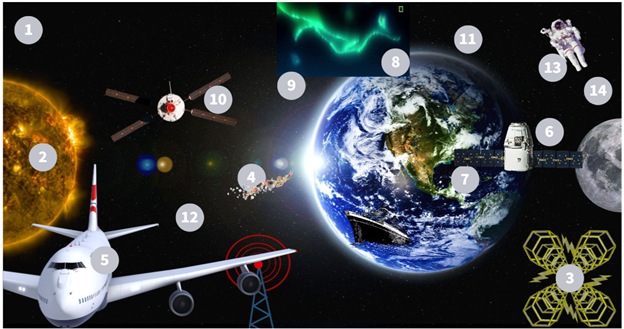
Topics include the impacts of ionospheric variability on HF propagation, satellite communications, and GPS, impacts of energetic charged particles on spacecraft, impacts of auroral precipitation on radar and communication systems, and impacts of varying geomagnetic activity on power grids and space domain awareness.
Between classes, students will have optional self-paced readings, exercises, knowledge checks, etc. available in the Johns Hopkins learning platform to enhance the course experience.
This course will explore the space environment in the context of its impact on space system operations. Topics include the impacts of ionospheric variability on HF propagation, satellite communications, and GPS, impacts of energetic charged particles on spacecraft, impacts of auroral precipitation on radar and communication systems, and impacts of varying geomagnetic activity on power grids and space domain awareness.
The goal of this course is to introduce students to space weather phenomena in the context of their impacts on space systems. Space weather is a new topic for many people, and it affects a wide variety of space systems. This course will demystify the topic of space weather from the perspective of a user of space systems. It provides a conceptual foundation for understanding all the critical impacts of the space environment on space systems without requiring pre-existing domain knowledge or any comfort level with the topic of space weather.
The course consists of six modules, each of which covers a different type of space weather, moving progressively from the Sun to orbital impacts and then to terrestrial impacts. By focusing on the impact of space weather, students will be able to understand both the technical context for the space environment and the relevance to systems that are familiar to a broader audience.
LEARNING OBJECTIVESBy the end of this course, you will be able to:
- Explain the Sun-Earth connection and how the space environment changes over time.
- Identify the full range of space environment impacts on technological systems.
- Predict localized space weather impacts based on observed environmental drivers.
- Analyze a space system to determine how it could be impacted by space weather.
- Describe how to design a space system to mitigate against relevant space weather impacts.
AUDIENCE- Primary Audience: Government, industry, academic, or commercial users of space systems without extensive space weather domain knowledge.
- Secondary Audience: Operational users of space systems or DoD / IC service members, civilians, or contractors.
- Tertiary Audience: Anyone who might be impacted by space weather with a desire to learn more about it.
COURSE FEES (Sign-In To Register)
- AIAA Member Price: $1595 USD
- Non-Member Price: $1795 USD
Additional AIAA/Johns Hopkins Courses: In Spring 2026, AIAA and Johns Hopkins University are jointly offering several courses focused on Space Systems Engineering. Those students wishing to deepen their knowledge may be interested the opportunity to participate in more than one of these courses:
- Fault Management and Autonomy for Space Systems – Online Short Course (Starts 7 April 2026)
- Introduction to Satellite Communications – Online Short Course (Starts 8 April 2026)
- Space Weather and Space Systems – Online Short Course (Starts 9 April 2026)
- Spacecraft Rendezvous and Proximity Operations – Online Short Course (Starts 28 April 2026)
------------------------------------------------------------------------------------------------------------OUTLINE
- Module 1 The Sun as a Driver of Space Weather
- Sun-Earth Connection
- Solar Flares and Short-Term Solar Impacts
- Module 2 Societal Impacts of Magnetic Storms
- Geomagnetic Storms and Power Grids
- Atmospheric Drag and Space Domain Awareness
- Module 3 Impacts of the Space Radiation Environment
- Radiation Belts
- Exposure Risks to Astronauts
- Module 4 Impacts of Energetic Charged Particles
- Surface and Internal Charging
- Single Event Effects and Total Dose
- Module 5 Auroral Impacts on Space Systems
- Auroral Precipitation and Radar Clutter
- Auroral Irregularities and High Latitude Scintillation
- Module 6 Ionospheric Impacts on Space Systems
- Ionospheric Effects on Position/Navigation/Timing
- Ionospheric Effects on Communications
INSTRUCTOR

Dr. Joseph Comberiate holds a Ph.D. in Electrical Engineering from the University of Illinois Urbana-Champaign where his dissertation focused on tomographic reconstruction of ionospheric electron density using space-based ultraviolet observations. He also holds M.S. and B.S. degrees in Electrical Engineering from University of Illinois.
Joe is the instructor and course developer for the ‘Space Weather and Space Systems’ graduate course at Johns Hopkins University. He is the Group Supervisor of the Space Algorithms and Technologies group at JHU/APL, where he has worked since receiving his Ph.D. in 2006.
CLASSROOM HOURS / CEUs: 12 classroom hours / 2.4
CEU/PDH
COURSE DELIVERY AND MATERIALS
- The course lectures will be delivered via Zoom. Access to the Johns Hopkins learning platform will be provided to registrants near to the course start date.
- All recorded classes will be available on-demand within 1-2 business days of the lecture. Once available, you can stream the replay video anytime, 24/7.
- All slides will be available for download after each lecture. No part of these materials may be reproduced, distributed, or transmitted, unless for course participants. All rights reserved.
- Between lectures during the course, the instructor will be available via email for technical questions and comments.
CANCELLATION POLICY: A refund less a $50.00 cancellation fee will be assessed for all cancellations made in writing prior to 5 days before the start of the event. After that time, no refunds will be provided.
CONTACT: Please contact Lisa Le or Customer Service if you have any questions about the course or group discounts.