- From 29 September–13 October 2026 (2.5 Weeks, 5 Classes, 10 Total Hours)
- Every Tuesday and Thursday at 1–3 p.m. Eastern Time (all sessions will be recorded and available for replay; course notes will be available for download)
- This new unique course is essential for anyone interested in understanding cavity flow and stores separating from weapon bays
- All students will receive an AIAA Certificate of Completion at the end of the course.
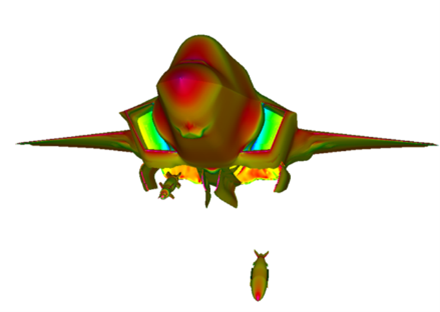
OVERVIEW
This new and unique course will discuss the physics of cavity
flow and the challenges for modeling and simulation. A brief modern history of the use of weapons
bays in military aircraft and the difficulties during a store separation event. The current research on studying store
separation from weapons bay and techniques for prediction will be
discussed.
LEARNING OBJECTIVES
- Understand use of weapons bays on military aircraft
- Understand the physics of cavity flow
- Understand the store separation challenges
- Understand predictive methods from analytical to computational
- Learn about current research in understanding store separation from a weapon bay
- Complete a series of exercises giving insight into cavity flow and store separation
AUDIENCE
Anyone interested in understanding cavity flow and stores
separating from weapon bays. Past,
present, and future application of modeling and simulation are drawn from the
author’s 40 years researching and modeling cavity flow. Expect to learn basics of cavity flow physics
along with several modeling techniques and challenges.
COURSE FEES (Sign-In
To Register)
- AIAA
Member Price: $695 USD
-
AIAA Student Member Price: $495 USD
- Non-Member Price: $895 USD
--------------------------------------------------------------------------------------------
- Physics of cavity flow
- Weapon bay history I
- Open and closed cavity
- Pipe-organ theory and Rossiter
- Time domain versus Frequency domain
- Rossiter success
- Improvements to Rossiter
- Exercise I: Rossiter - DeChant
- Store separation challenges
- Weapon bay history II
- Exercise I Review
- Stores in cavity
- Flow during store release
- Competing Time-characteristics
- Flow modification
- Exercise II: Shear Layer thickness prediction
- Predictive methods from analytical to computational
- Weapon bay history III
- Exercise II Review
- Amplitude estimates
- Repeatability prediction: J-factor
- Improvements to J-factor
- Exercise III: J-Factor Improvements
- Current research in understanding store separation from a weapon bay
- Weapon bay history IV
- Exercise III Review
- Machine learning to compute accurate cavity flow
- Store release Monte-Carlo simulations with unsteady flows
- Reduced-order techniques
- Exercise IV: JUMP
- Store Separation Practice
- Weapon bay history V
- Exercise IV Review
- JUMP cases and variations
- Review & Summary
INSTRUCTOR

Bruce Jolly, CEO / Chief Technologist, Aero SME Consulting LLC. Retired as the US Air Force SEEK EAGLE Office (AFSEO) Principal Technical Advisor for Modeling and Simulation and selected by the US Air Force Academy (AFA) as a Visiting Scholar. Bruce joined the AFSEO in 1993 to insert Computation Fluid Dynamics (CFD) to be used in support of store compatibility. Over the next 32 years Bruce developed and proved the use of modeling and simulation to become the premier production CFD capability within the Air Force. Three generations of advanced CFD methods and many generations of high computing advancements later M&S supports every discipline within the SEEK EAGLE process. Recognized as a national subject matter expert in unsteady aerodynamics, CFD, and nuclear production technology, Bruce has supported many academic institutions, government laboratories, Von Karmon Institute, and the nation’s top security organizations for the past 25 years. He continually develops new methods for predicting the effects of the unsteady nature inside weapons cavities on store release. Over the past 20 years he has mentored AFA cadets’ summer research with AFSEO to over 40 cadets. Bruce is a sought-after lecturer having lectured internationally in Belgium, Sweden, Spain, Netherlands, and Canada as well as publishing over 30 technical papers presented nationally and internationally. He is an American Institute of Aeronautics and Astronautics Associate Fellow.
Classroom Hours / CEUs: 10
classroom hours, 1.0 CEU/PDH
Course Delivery and Materials
- The course lectures will be delivered via Zoom.
- All sessions will be available on-demand within 1-2 days of the lecture. Once available, you can stream the replay video anytime, 24/7. All slides will be available for download after each lecture.
- No part of these materials may be reproduced, distributed, or transmitted, unless for course participants. All rights reserved.
- Between lectures, the instructors will be available via email for technical questions and comments.
Cancellation Policy: A refund, less a $50.00 cancellation fee, will be assessed for all cancellations made in writing prior to 7 days before the start of the event. After that time, no refunds will be provided.
Contact: Please contact Lisa Le or Customer Service if you have questions about the course or group discounts (for 5+ participants).